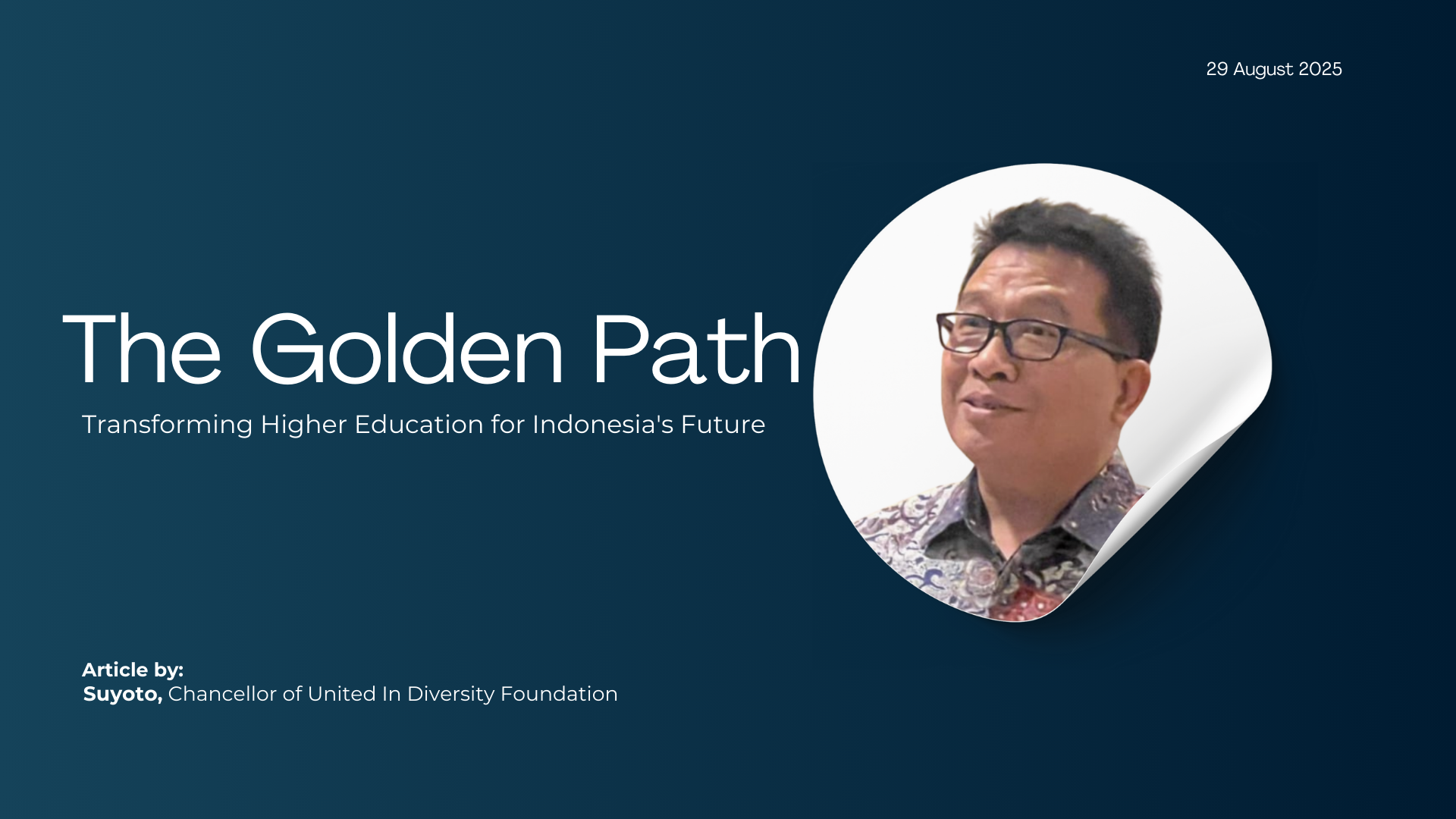
The Golden Path: Transforming Higher Education for Indonesia's Future
A nation thrives only if it can adapt and innovate. History shows that civilizations that fail to anticipate change are left behind. Higher education exists precisely to drive this process of adaptation—producing outstanding individuals, generating new knowledge, and creating innovations that matter.
As Edward Clewley (2020) argues, the growth of universities has always paralleled regional economic growth. The Massachusetts Institute of Technology (MIT), for instance, is estimated to contribute nearly 10% of the U.S. GDP, largely through companies founded by its alumni.
In Indonesia, this vision is embodied in the Tri Dharma Perguruan Tinggi (the Three Pillars of Higher Education). Yet, in practice, universities often fall into academic and administrative routines. True synergy among students, faculty, industry, government, and society remains underdeveloped. Without such collaborative ecosystems, higher education cannot deliver long-term social impact.
Many, but Are They Relevant?
Indonesia currently has 26,886 study programs across public and private universities. Their fields are diverse: education (5,700), engineering (4,800), social sciences (4,100), health (3,300), economics (3,300), agriculture (1,800), religion (1,700), mathematics and natural sciences (1,000), humanities (719), and arts (385) (Directorate General of Higher Education, 2021).
The numbers are impressive, but the key question is: are these programs relevant to the nation’s challenges? Too often, new programs emerge merely to follow trends. In the 1980s–90s, agriculture and education dominated; more recently, informatics and economics. Frequently, programs are opened not out of future necessity, but as a strategy for universities to attract students and survive.
Another barrier lies in regulation. The rigid requirement that faculty degrees (S1–S2) be strictly linear makes it difficult to establish urgently needed interdisciplinary programs, such as logistics or supply chain management. President Joko Widodo has repeatedly emphasized that higher education must be adaptive and anticipatory—not merely replicating what already exists.
Lessons from Designing New Programs
I was involved in designing Happy Digital X: Cities, Systems, Products, and Services, a collaborative initiative of United In Diversity with Prof. Edward Crawley (MIT) and Tsinghua University. This program was created to address the challenges of sustainable digital urban transformation.
From this experience, I learned that academic programs must be designed based on real needs. The process starts with identifying challenges, listening to stakeholders, benchmarking globally, engaging experts, and ensuring continuous evaluation. The cycle never ends, a process that echoes the wisdom of the late A. Malik Fadjar: “Start from the beginning and the end.”
With such an approach, a program becomes more than a classroom; it becomes a hub of synergy. Students don't just learn theories; they engage with real-world problems and craft meaningful solutions.
A National Transformation Agenda
This vision aligns with the policy direction of Prof. Brian Yuliarto, Indonesia’s Minister of Higher Education, Science, and Technology. He emphasizes that higher education is the key to realizing Golden Indonesia 2045.
Through the Diktisaintek Berdampak initiative, he urges universities to be:
Equitable – expanding access and ensuring quality across the country.
Relevant – programs and research must address real societal needs, not fleeting trends.
Socially impactful – innovations should benefit communities, not remain locked in journals.
Prof. Brian also promotes the idea of University 4.0: inclusive, innovative, sustainable, and collaborative within the quadruple helix (academia–industry–government–society). He insists that building world-class universities must not detach them from national priorities such as food security, energy, health, and downstream industrialization.
Global Inspiration
There is much to learn from the world. MIT is a model of the entrepreneurial university through its Triple Helix approach. In Chile, the Clover 2030 Engineering Strategy has reformed engineering education with shorter programs, socially responsible research, and multidisciplinary collaboration.
International networks such as ECIU (Europe) and AUA (Asia) demonstrate that university alliances can enhance student mobility, joint research, and regional innovation.
Toward Golden Indonesia
To realize the Golden Indonesia 2045, our higher education system must break free from formalism and short-lived trends. Programs should be rooted in the nation’s actual needs, executed with continuous evaluation, and supported by policies that prioritize social impact.
With strong synergy among academia, industry, government, and society, higher education can be the foundation of a sovereign, self-reliant, and globally competitive nation. This is the moment to ensure that study programs don't merely produce graduates, but create real solutions for Indonesia’s future.
To foster momentum and provide a clear roadmap for transformation, United In Diversity Foundation offers a collaborative forum based on the expanded CDIO framework. The process begins with self-assessment and institutional roadmapping. From there, each university can play multiple roles—as learner, partner, and accelerator. The strength of one institution can become a positive force for others. No progress is possible without an atmosphere of inclusive collaboration—our own modern form of gotong royong.
Jakarta, August 29, 2025