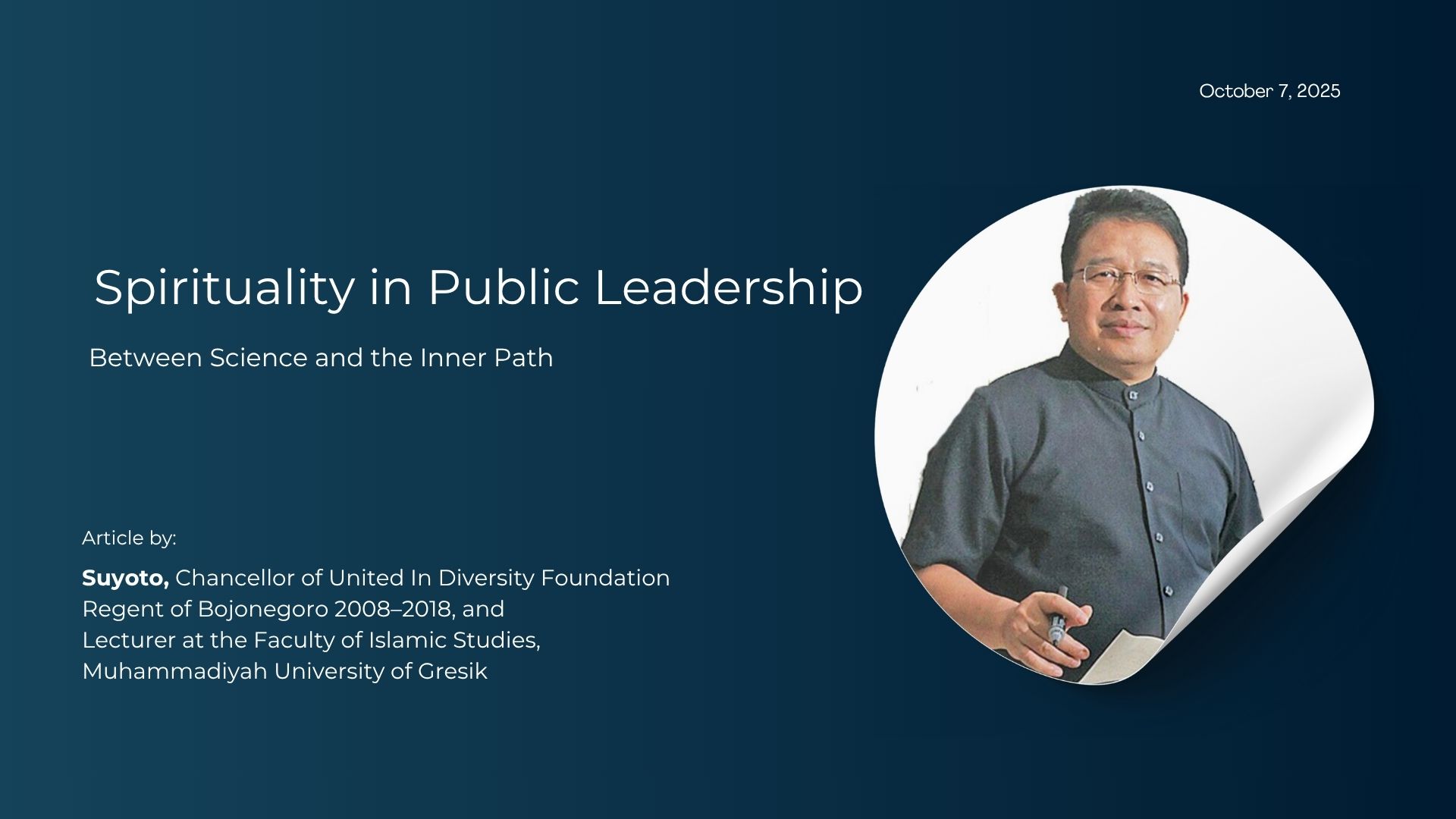
Spirituality in Public Leadership: Between Science and the Inner Path
In 2011, after researching my leadership journey in Bojonegoro, Otto Scharmer from MIT—the founder of Theory U—was asked a question: who, really, is Kang Yoto? His answer surprised even me:
“Kang Yoto is a spiritual leader, a leader who works in the political field in emerging well-being for all.”
According to him, I was not just a political leader, but a spiritual leader working within the political arena to foster well-being for everyone.
A few years later, Prof. Abdul Munir Mulkhan wrote the book Kepemimpinan Spiritual Transformatif Kang Yoto (2016). He described politics as a thariqah sufiyah—a Sufi path—for me. These two perspectives deepened my awareness that public leadership is not merely a political and managerial process; it is a spiritual journey demanding a balance between reason, emotion, and divine consciousness.
Politics and Spirituality: Two Worlds That Can Merge
In the public imagination, politics is often perceived as a harsh world, full of intrigue and self-interest. Yet, field experience shows that these are the spaces where spirituality is truly tested.
Every public leader will face critical moments—in times of difficulty and of success. It is there that spiritual values find their relevance.
I have experienced moments of near-despair, of being scorned, abandoned, and even humiliated. In such situations, spirituality became my inner resource, nurturing sincere intention, persistent effort (mujahadah), patience (sabar), acceptance (ridha), and sincerity (ikhlas). This spiritual energy guided me to keep striving, not out of a thirst for power, but from a belief in a greater good.
Conversely, when success arrived—winning an election, receiving an award, or earning praise—the spiritual path served as a safeguard against the intoxication of power. True success is not a personal achievement, but the fruit of harmony between society, nature, and the will of God. The principle of eling lan waspada (constant remembrance and mindful vigilance) became my anchor, allowing me to remain humble and aware that a position is a sacred trust (amanah)-- never a privilege to be boasted about.
Science and Spirituality in Leadership
Over the last two decades, extensive research in the neuroscience of leadership and spiritual leadership theory has affirmed the importance of the inner dimension in leadership.
Researchers like Louis Fry (2003) describe spiritual leadership as the ability to foster a sense of calling (life's purpose) and membership (a feeling of connectedness) within an organization. These two elements cultivate intrinsic motivation and profound meaning in public service.
Meanwhile, neuroscience has identified a center for moral and spiritual consciousness in the brain—often called the ‘God spot’—which plays a crucial role in altruistic and empathetic decision-making. When this area is active, a person tends to think clearly, act humbly, and feel moved to serve. This is the scientific basis for why spirituality is not merely a religious matter, but also the biological and psychological dimension that underpins sustainable leadership.
In my experience, sound public decisions are not solely the result of rational calculation, but also the integration of reason, empathy, and spiritual awareness. A spiritually conscious leader will be more cautious in wielding power, more sensitive to the suffering of the people, and more capable of balancing outcomes with holistic well-being.
Cultivating Spirituality in Public Leadership
A leader's spiritual quality does not appear suddenly. It is born from the practice of awareness and the discipline of self-reflection. I have found several things to be essential:
• Noble Intention – Viewing a position as a trust (amanah) to spread benefit, not to seek personal glory.
• Reflection and Silence – Making time for contemplation, listening to the inner voice, and engaging in self-dialogue. In silence, we often find wisdom that does not emerge in the noise of politics.
• Empathy and Ecosystem Awareness – Recognizing that every policy impacts people, nature, and the future.
• Sincerity and Humility – Accepting success without arrogance, facing failure without resentment.
• Gratitude and Love – Transforming every experience, both bitter and sweet, into a source of learning and compassion.
Conclusion
Spiritual leadership does not mean withdrawing from the world, but rather engaging with it through a deeper consciousness. It does not negate science, but integrates it with conscience.
In a political landscape that is often harsh and pragmatic, spirituality becomes a guiding light: ensuring that a leader is not only intelligent, but also wise; not only powerful, but also compassionate.
Perhaps Otto Scharmer was right: spiritual leaders are those who work in the political world, yet whose hearts are rooted in love and well-being for all. And perhaps that is the true essence of public leadership—to serve with an awareness of the Divine presence.
Jakarta, October 7, 2025