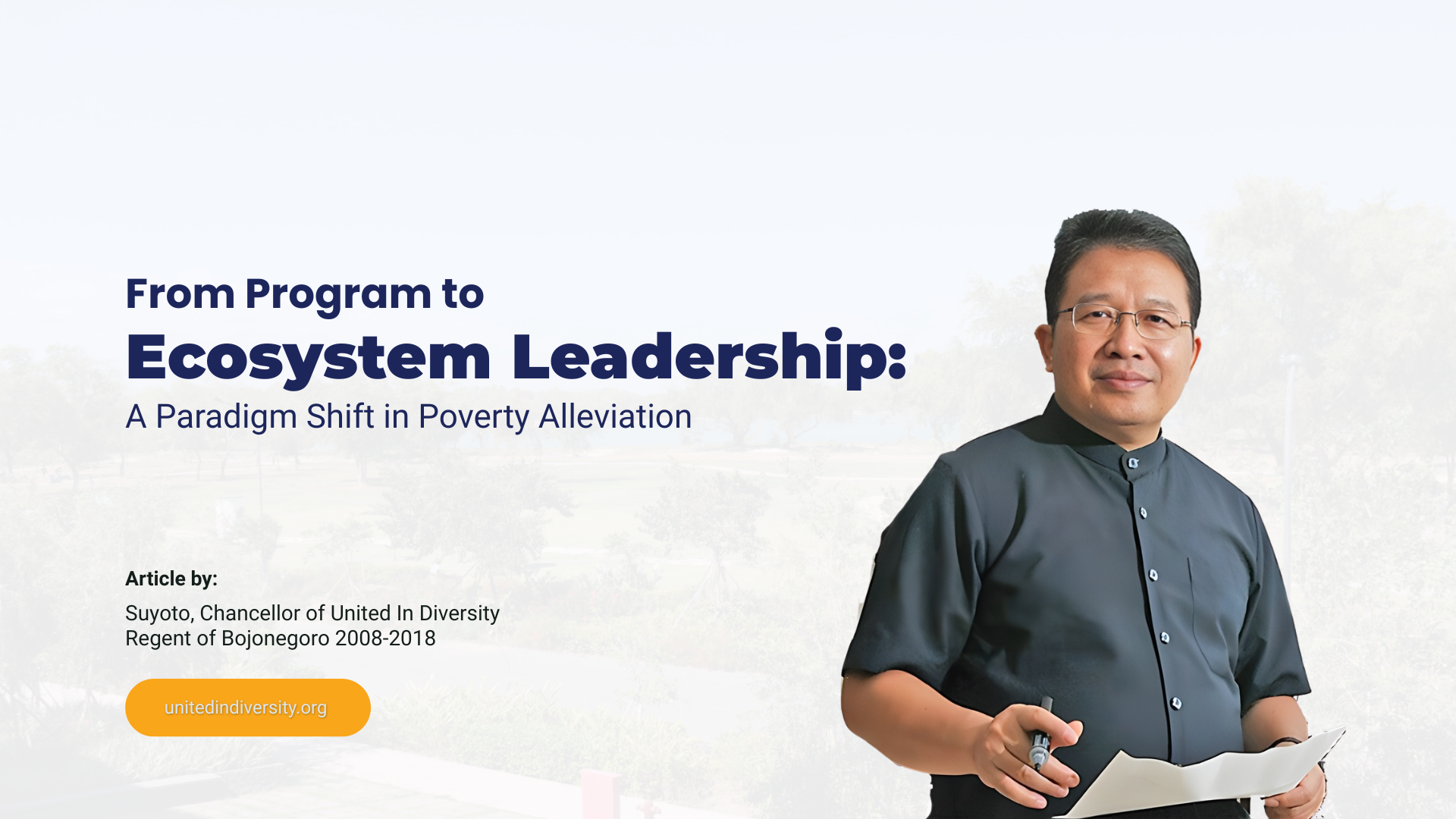
From Programs to Ecosystem Leadership: A Paradigm Shift in Poverty Alleviation
Poverty remains the greatest paradox of development. Despite increasing budgets, expanding programs, and richer data, far too many citizens still live in scarcity—even in resource-rich regions. This highlights a fundamental truth: poverty is not merely a lack of aid; it is a sign that something is broken in how we perceive, design, and manage development.
While Indonesia has consistently reduced poverty over the last two decades, the pace is slowing and remains uneven. Data from the Ministry of Villages and Development of Disadvantaged Regions (2025) shows rural poverty at 11.34% in 2024, nearly double that urban areas. More strikingly, the rate of decline in rural poverty has decelerated from 0.78% per year (2007-2015) to just 0.3% (2015 -2024). This tells us that our current “business as usual” approach is no longer enough to tackle today’s complexities.
The issue isn’t just about “how much” budget we have, but “how” we manage it. Resource-rich areas often struggle with high poverty rates, while resource-constrained regions find ways to thrive. Clearly, the secret lies in the quality of management and leadership.
Poverty as a Systemic Symptom
We often treat poverty as a sectoral issue to be solved with social assistance or isolated economic interventions. In reality, poverty is a symptom of a system that is not functioning as a whole. It is deeply intertwined with education, healthcare, infrastructure, economic structures, and social relations.
Learning from global—such as China’s rapid transformation—we see that significant poverty reduction requires a simultaneous blend of economic growth, social protection, and empowerment. Of course, China’s model involved strong state coordination and unique political and land rights context that are not directly transferable. Nevertheless, as William N. Brown (2021) notes, the broader shift must move from “giving aid” to “enabling”—focusing on productivity, skills, and market access, all rooted in local context.
The Call for Ecosystem Leadership
Beyond policies and budgets, the decisive factor is leadership. At United In Diversity (UID), we believe in the power of Ecosystem Leadership—the ability to read reality and move the entire system toward a common goal. This leadership is rooted in four pillars of awareness:
1. Spatial Awareness: Understanding the physical landscape—where poverty pocket are and how geography dictates the local economy.
2. Social Awareness: Recognizing that poverty is bound by culture, norms, and social networks. What works in one village may fail in another.
3. Historical Awareness: Acknowledging that today’s conditions are the result of long-term processes. Without history, we are doomed to repeat the same mistakes.
4. Spiritual Awareness: Seeing leadership as a life calling. This elevates policy beyond short-term popularity toward a commitment to sustainable, collective well-being.
From Program to Transformation
Program-based approaches focus on outputs: budgets spent, kits distributed, boxes ticked. However, these rarely spark true transformation.
An ecosystem approach positions the leader as a “bridge-builder” who harmonizes government, the private sector, and civil society. This meaning shifting toward:
- Area-based interventions rather than narrow sectors.
- Strengthening local economies based on unique regional character.
- Building value chains that ensure the community captures the added value of their work.
What does this look like in practise? Instead of simply distributing free seeds to farmers, an ecosystem leader would first map soil conditions, assess local market access, link farmers to microfinance institution, and coordinate with buyers to guarantee fair process. The program becomes a catalyst—not a crutch.
Avoiding the Populist Trap
The greatest temptation for any leader is the “quick fix”—populist programs that win votes but create long term dependency. While immediate aid is often necessary, it must serve as a bridge to independence, not a final destination. The government must evolve from being a mere “distributor” of aid to becoming the “orchestrator” of a developmental ecosystem.
Poverty reduction is not a technical problem; it is a perspective problem.
If we see poverty as a program failure, our solutions will always be limited. But when we view it as a systemic symptom and address it through ecosystem leadership grounded in dee awareness, the resulting change is profound and enduring.
In the end, it is not the data, the budget, or the program that determines success—it is the quality of leadership that moves the whole system toward a better future.
Suyoto
Chancellor, United In Diversity | Regent of Bojonegoro 2008-2018