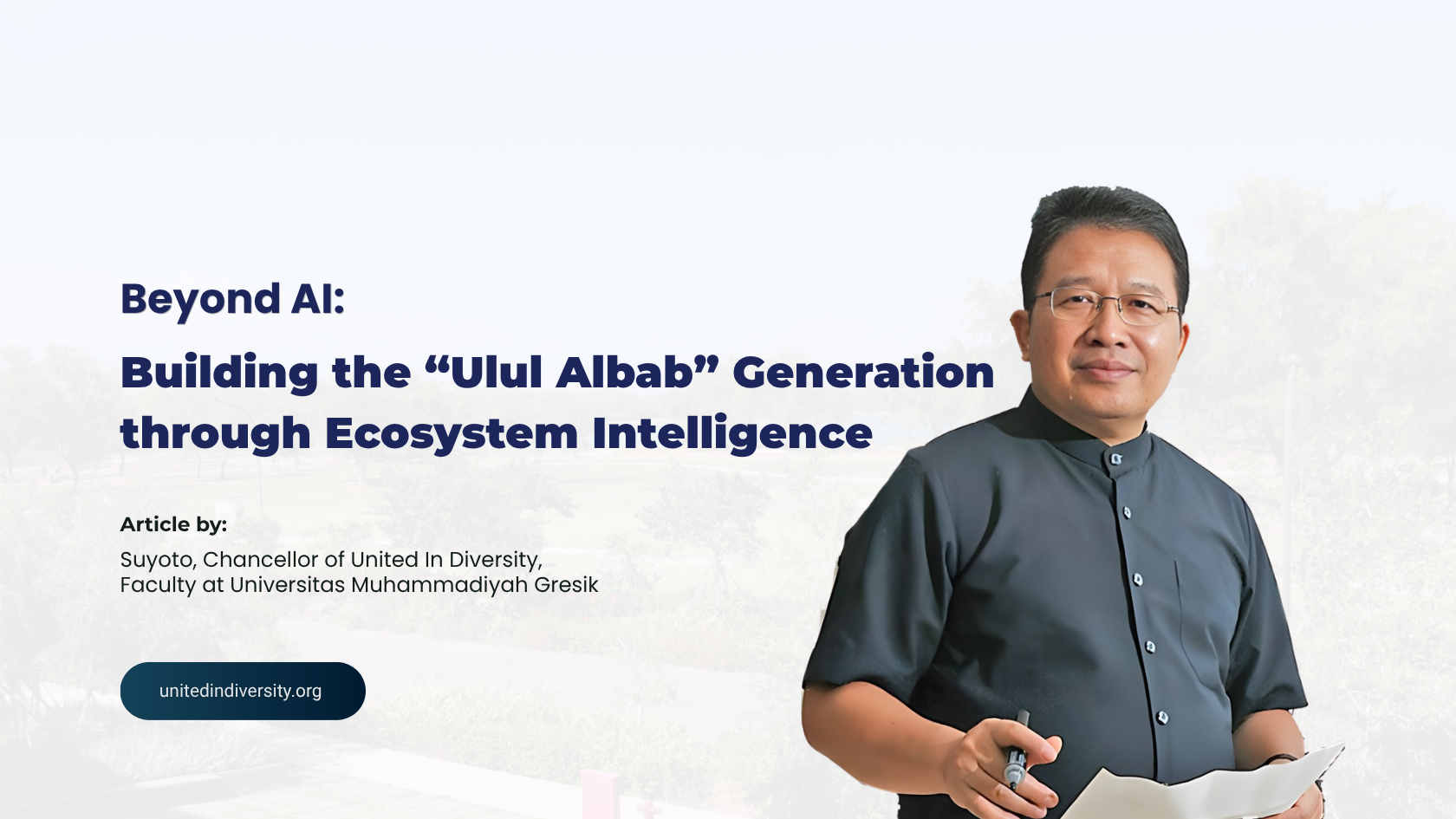
Beyond AI: Building the “Ulul Albab” Generation through Ecosystem Intelligence
By: Suyoto (Chancellor of United In Diversity and Faculty at Unmuh Gresik)
Today’s world is weathering a massive upheaval known as disruption. The presence of Artificial Intelligence (AI) is no longer a sci-fi trope; it is a reality present in our classrooms, workplaces, and daily lives. Many parents are understandably anxious, asking: “Will my child’s profession still be relevant?” or “Will the role of humans be replaced by machines?”
Having journeyed from a small-town madrasah to serving as a lecturer, rector, regent, and now with United In Diversity, I view these changes with realistic optimism. The future does not belong solely to those who excel academically, but to those who possess Ecosystem Intelligence—the ability to understand the relationships between actors, the dynamics of various factors across time and space, and the capacity to respond with solutions that serve the well-being of the entire web of life.
Transformation: From Madrasah to the Digital Era
My life journey demonstrates that a humble background with a strong religious foundation is not a barrier, but a primary asset. The madrasah taught me resilience (mujahadah) and integrity—two values that serve as timeless “software” that no machine can ever replicate.
AI may process data exponentially faster than humans, but it lacks bashirah—the clarity of the heart’s eye. The Al-Qur’an reminds us:
“So have they not travelled through the earth and have hearts by which to understand…”
(QS. Al-Hajj: 46)
This verse affirms that the pinnacle of humanity lies not in cognitive intelligence alone, but in the ability to grasp meaning, feel empathy, and derive wisdom (hikmah). This is the foundation of character.
Future Skills: Beyond Technical Proficiency
In the era of AI, technical skills like coding are no longer enough. Ecosystem Intelligence rests on three primary pillars:
First: Learning Agility
The humans of the future are lifelong learners. The Prophet Muhammad (PBUH) said, “Seeking knowledge is an obligation upon every Muslim.” In today’s context, learning means more than just acquiring information; it is the ability to learn and unlearn. This aligns with Alvin Toffler’s insight: “The illiterate of the 21st century will not be those who cannot read and write, but those who cannot learn, unlearn, and relearn.”
Second: Ecosystem Leadership
The future is hyper-connected. It is not enough to educate children to be personal successes; they must be capable of fostering collaboration and harmony amidst diversity. This resonates with Peter Senge’s concept of the Learning Organization—communities that learn and adapt collectively. Furthermore, as Fritjof Capra emphasizes, life must be understood as a “web of life” where every element is interconnected. Future leadership is the ability to read this network holistically—integrating historical, social, environmental, and spiritual awareness.
Third: Creativity in solving Ecosystem Challenges
AI operates based on past patterns, whereas humans excel at co-creating the future. We need the Ulul Albab—those who reflect deeply on creation to bring forth tangible solutions for humanity. This mirrors Otto Scharmer’s concept of Presencing: the ability to sense the future that wants to emerge and act from that heightened state of awareness.
Synergy of School, Parents, and Community
Ecosystem Intelligence cannot be built by schools in isolation. Parents, communities, and social organizations are integral. Parents are a child’s first “ecosystem architects.”
If education focuses only on rote memorization without understanding, or grades without character, we are preparing our children to be outpaced by machines. Instead, our social environments must become living classrooms. Children must be encouraged to see the real world, embrace its complexity, and discover their unique role within it.
Closing
Artificial Intelligence is both a challenge and a powerful tool for those with vision. Let us equip our children with faith as their anchor and knowledge as their wings. Beyond that, let us build Ecosystem Intelligence as a roadmap for Amal Saleh (righteous actions) and profound contribution.
Life experience teaches us that limitations are not obstacles as long as there is a burning curiosity and a will to serve. It is time to build an educational ecosystem that produces more than just “smart” individuals, but a “conscious generation—aware of their role as khalifah (stewards) who bring Rahmatan lil ‘Alamin (mercy to all worlds).
Jakarta, April 26, 2026